Laparoscopic Myomectomy
Minimally invasive fibroid removal with full preservation of the uterus and fertility — 3D laparoscopy, uterine wall reconstruction, EndoBag technique.
What Is Laparoscopic Myomectomy?
Laparoscopic myomectomy is a minimally invasive surgical procedure for the removal of uterine fibroids (myomas) while completely preserving the organ and the patient's fertility. Unlike hysterectomy, which involves removing the entire uterus, myomectomy targets only the fibroids — benign smooth-muscle tumours affecting 20–40% of women of reproductive age.
Fibroid Classification and Diagnostics
- Submucosal fibroids — grow into the uterine cavity, causing heavy bleeding and fertility issues
- Intramural fibroids — within the uterine wall, the most common type; may distort the cavity
- Subserosal fibroids — on the outer surface of the uterus; cause pressure on surrounding organs
- Pedunculated fibroids — attached by a stalk; may undergo torsion
Diagnostics include ultrasound as the first-line tool, supplemented by MRI (magnetic resonance imaging) as the gold standard for precise mapping of fibroid size, number, and location before surgery.
Advantages of the Laparoscopic Approach
- Minimal pain — significantly less than open surgery
- Fast recovery — return to daily activities within 7–14 days
- Preservation of the uterus and fertility — crucial for women planning pregnancy
- Lower risk of postoperative adhesions
- Superior cosmetic outcome — 3 small incisions instead of a large abdominal cut
Surgical Technique
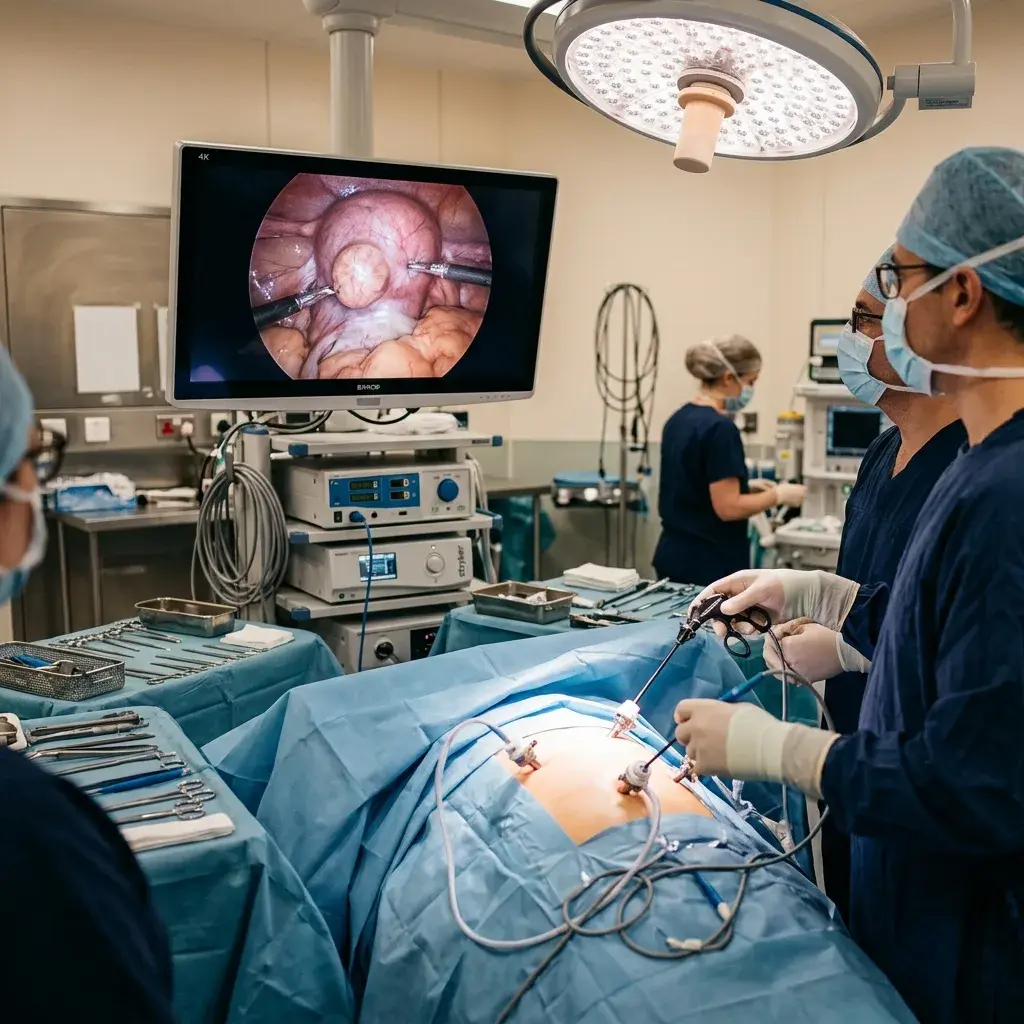
The operation is performed under general anaesthesia via laparoscopy (3–4 port access, 5–12 mm). Key steps:
- Fibroid enucleation — careful dissection of the fibroid from its bed without damaging the surrounding myometrium
- Uterine wall reconstruction — layered suturing in 2–3 layers for maximum strength
- Morcellation in an EndoBag — the fibroid is placed in a protective bag and fragmented within it, eliminating the risk of tissue dispersal into the abdominal cavity
Who Is a Candidate for Laparoscopic Myomectomy?
- Women with symptomatic fibroids (heavy bleeding, pain, pressure)
- Women planning pregnancy who wish to preserve the uterus
- Patients whose fibroids are causing fertility problems
- Women who wish to avoid hysterectomy
Outcomes and Pregnancy After Myomectomy
Laparoscopic myomectomy has an excellent fertility preservation rate. Most patients can plan pregnancy 6–12 months after the procedure, with mandatory ultrasound monitoring of uterine wall recovery. Delivery is planned by elective caesarean section when fibroids involved deep myometrial layers.
Read also:
Uterine fibroids: first symptoms →
Performed by
Dr Đorđe Petković
Consultant in Operative & Endoscopic Gynaecology · 17+ years of experience
Patients often ask
Yes. Unlike hysterectomy, laparoscopic myomectomy removes only the fibroids while fully preserving the uterus and the possibility of future pregnancy.
Recovery is fast — most patients return to daily activities within 7–14 days. Full physical activity resumes in 4–6 weeks.
Pregnancy can be planned 6–12 months after the operation, with mandatory ultrasound monitoring of uterine wall recovery.
An EndoBag is a protective surgical pouch into which the fibroid is placed before morcellation. It prevents tissue dispersal into the abdominal cavity, ensuring maximum safety.
MRI is the gold standard for precise mapping of fibroid size, number, and location. It is recommended before every planned myomectomy.
Both solitary and multiple fibroids can be successfully removed laparoscopically. The number and size are assessed individually based on MRI findings.