
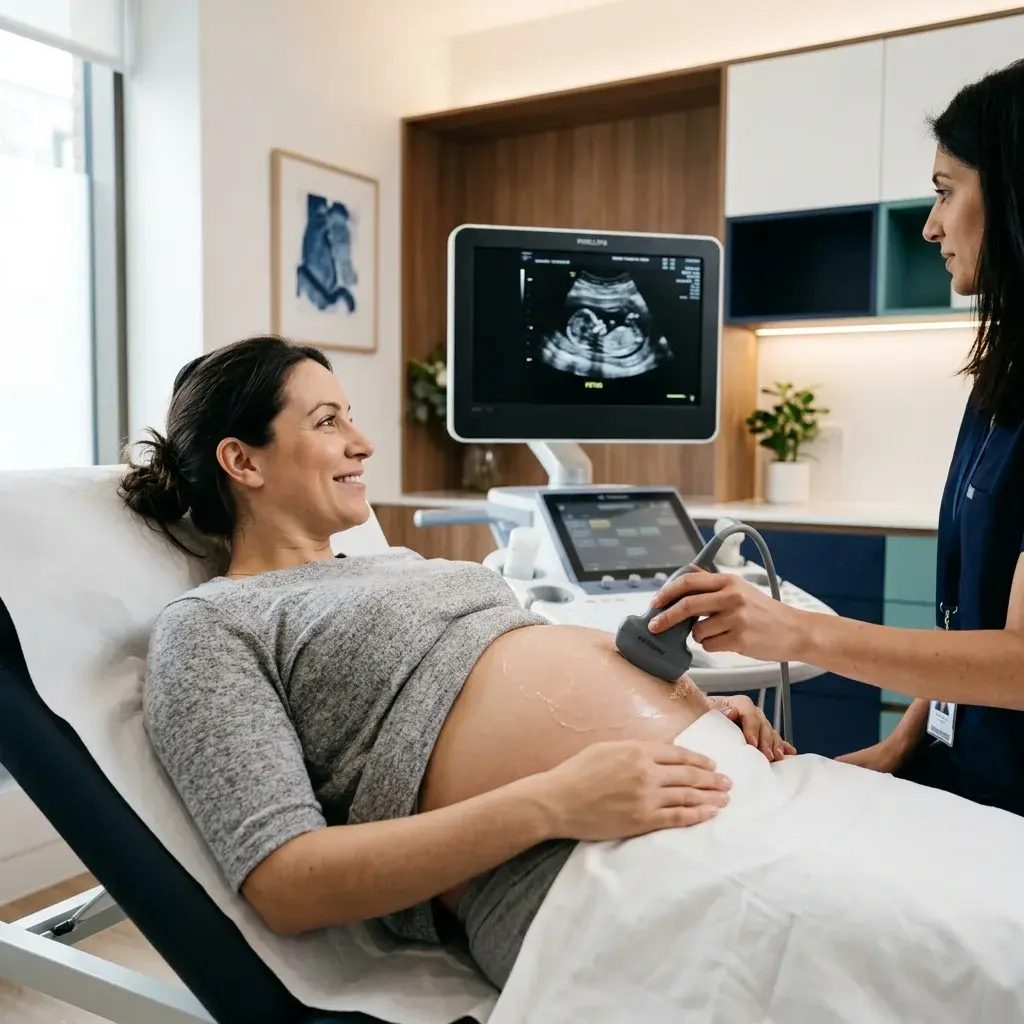
First Trimester Screening
The most important preventive examination in early pregnancy for accurate assessment of fetal health, performed by an FMF certified specialist.
The first trimester screening (combined screening) is the most important preventive examination in early pregnancy. This non-invasive test is performed between the 11th and 14th week of pregnancy (11+0 to 13+6) with the aim of early detection of chromosomal anomalies and assessing the risk of complications in later pregnancy. By combining ultrasound examination, biochemical markers from the mother's blood, and a detailed medical history, we provide a highly accurate risk assessment with a detection rate of up to 95%.
What does the first trimester screening involve?
The combined screening consists of two main components analyzed together using specialized software (FMF - Fetal Medicine Foundation). The procedure is completely safe for both mother and fetus.
- Ultrasound examination: A high-resolution ultrasound measures nuchal translucency (neck fold), assesses the presence of the nasal bone, analyzes blood flow through the ductus venosus and tricuspid valve, and evaluates early fetal anatomy.
- Biochemical screening (Double test): The levels of two specific hormones (PAPP-A and free beta-hCG) are determined from the mother's blood sample. Changes in these marker levels, correlated with ultrasound findings, indicate potential risks.
Why choose an FMF certified doctor?
The reliability of the first trimester screening depends directly on the doctor's expertise and the quality of the ultrasound machine. At Palmotićeva Clinic, examinations are performed by Dr. Đorđe Petković, an FMF certificate holder (The Fetal Medicine Foundation, London).
- Standardization: Measurements are performed according to the strict, internationally recognized criteria of the Fetal Medicine Foundation.
- State-of-the-art software: Risk is calculated using licensed FMF software based on the latest algorithms.
- Annual audit: The certificate requires regular annual quality control of results.
What does the examination look like?
The examination usually takes about 30-45 minutes and includes several steps:
- Consultation and medical history: Taking detailed information about age, weight, previous pregnancies, and family medical history.
- Expert ultrasound: Detailed examination of the fetus, confirmation of gestational age, measurement of CRL (crown-rump length) and nuchal translucency.
- Blood draw: On the same day or the day after at the latest, the patient has a blood draw for the Double test in a reference laboratory.
- Result interpretation: Computer processing of all parameters provides the final risk (e.g., 1:2500) which you discuss in detail with your doctor.
What conditions does the screening detect?
The primary goal of screening is to assess the pregnant woman's individual risk for specific chromosomal abnormalities and anatomical defects.
- Trisomy 21 (Down syndrome): The most common chromosomal disorder.
- Trisomy 18 (Edwards syndrome) and Trisomy 13 (Patau syndrome): Early detection of severe genetic anomalies.
- Early anatomy: Recognition of major structural abnormalities of the fetus (such as some heart defects or neural tube defects).
- Pre-eclampsia risk: By adding blood pressure measurement and blood flow through the uterine arteries, the risk of early development of hypertension in pregnancy can be assessed.

Performed by
Dr Đorđe Petković
Consultant in Operative & Endoscopic Gynaecology · 17+ years of experience
Patients often ask
The screening is done when the pregnancy is between 11 weeks and 0 days (11+0) to 13 weeks and 6 days (13+6). The fetal CRL must be between 45mm and 84mm.
No, fasting is not required for the Double test (biochemical screening).
Results are generated as soon as we receive the values from the laboratory, usually within 24 to 48 hours.
Yes, alongside the screening we can measure blood flow parameters and assess your personal risk.
If the risk is high, Dr. Petković will advise you on further diagnostic procedures such as NIPT (non-invasive prenatal testing), chorionic villus sampling (CVS), or amniocentesis.
Yes. Although NIPT is highly accurate for chromosomes, it does not provide information about fetal anatomy. An expert ultrasound remains essential.